
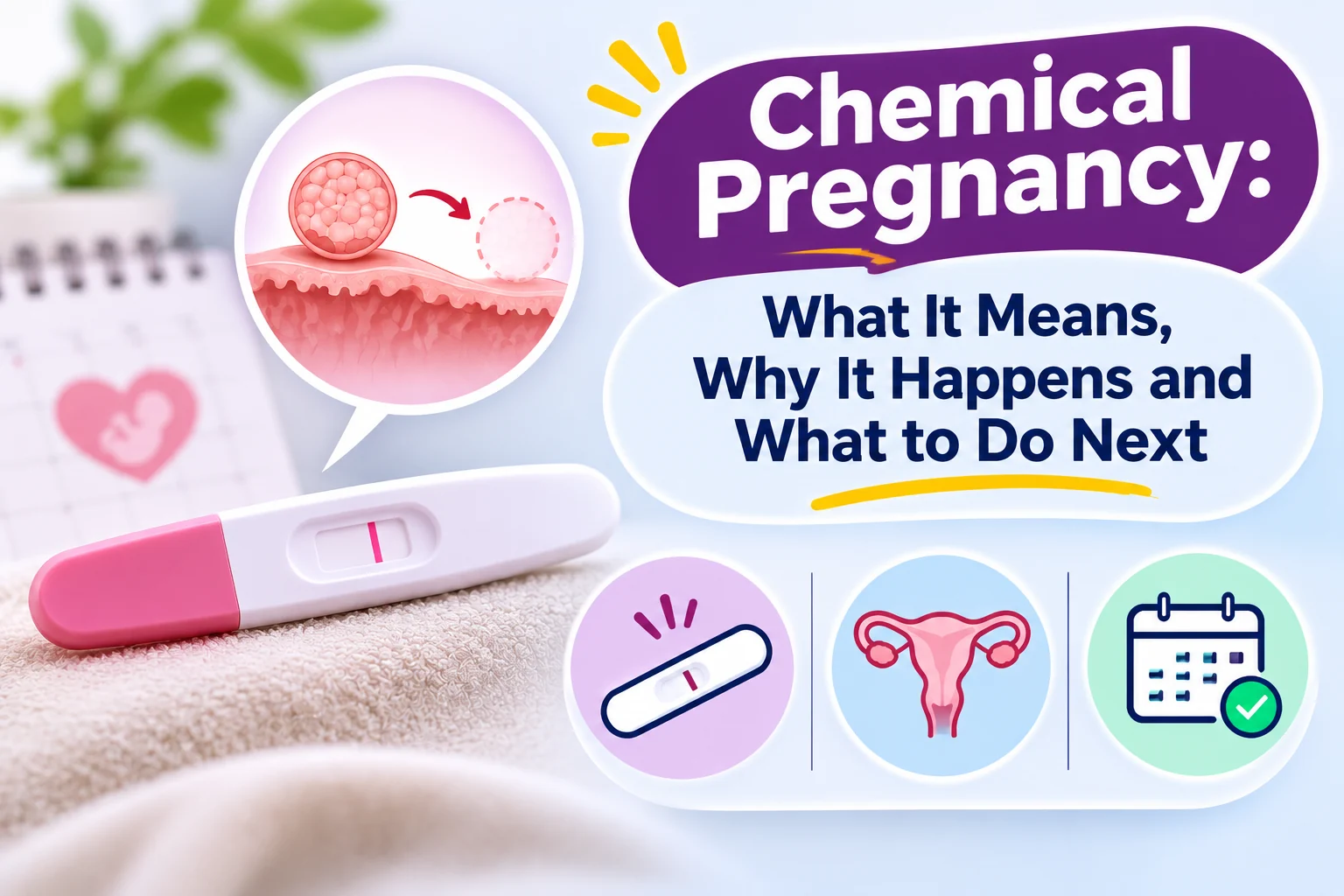
Chemical Pregnancy: What It Means, Why It Happens and What to Do Next
QUICK ANSWER : A chemical pregnancy is a pregnancy that ends very early, usually around 4 to 5 weeks, before anything can be seen on a scan. The pregnancy test turns positive, then the hCG level falls and a period comes. One chemical pregnancy is common and usually needs no tests. Two or more pregnancy losses, including chemical ones, are a reason to see a fertility specialist.
You saw two lines on the test. Maybe you told your husband, maybe you didn't. A few days later your period came, a little heavier than usual, and a repeat test was faint or negative. If your doctor called it a "chemical pregnancy", you may be wondering what that even means, and whether something is wrong.
This guide explains it in plain words: what a chemical pregnancy is, why it happens, what the hCG numbers mean, when it is worth looking deeper, and what to do next.
What is a chemical pregnancy?
A chemical pregnancy is a very early pregnancy loss. The embryo starts to implant in the lining of the uterus and begins making the pregnancy hormone hCG. That is enough to turn a urine or blood test positive. But the pregnancy stops developing before a pregnancy sac can be seen on ultrasound.
Doctors also call it a biochemical pregnancy or a biochemical pregnancy loss. The word "chemical" only means the pregnancy was confirmed by a chemical (hormone) test, not by a scan. It does not mean anything you ate, drank or used caused it.
Chemical pregnancy at 5 weeks: why the timing is so early
Most chemical pregnancies end around the time your period is due or within a week after it, so roughly 4 to 5 weeks counted from your last period. That is why many women never know they had one. Sensitive home tests have simply made these very early losses easier to see.
Signs of a chemical pregnancy
There is often no clear sign. When there are signs, they usually look like this:
- A positive pregnancy test, followed by a fainter line or a negative test a few days later
- A period that comes on time or a few days late, sometimes heavier or with small clots
- Mild cramps, similar to period pain
- A blood hCG level that is low, or that rises slowly and then falls
Bleeding alone does not tell you it is a chemical pregnancy. Some bleeding in early pregnancy is common and harmless, and bleeding with one-sided pain can be a sign of an ectopic pregnancy, which needs urgent care. If you have a positive test and then bleeding, call your doctor rather than guessing.
Chemical pregnancy and beta hCG levels
A blood test for beta hCG is the only way to confirm what happened. In a healthy early pregnancy, hCG usually rises steadily over 48 hours. In a chemical pregnancy, the level is often low to start with, rises slowly or stops rising, and then falls back to zero.
There is no single hCG number that says "this pregnancy will continue" or "this pregnancy will end". That is why doctors look at the trend over two or three tests rather than one value. If you are in an IVF cycle, your clinic will tell you which day to test and when to repeat it.
Why does a chemical pregnancy happen?
In most cases, the reason sits with the embryo itself. Across early pregnancy loss in general, about half of losses are caused by chromosome errors in the embryo, according to the American College of Obstetricians and Gynecologists (ACOG Practice Bulletin No. 200, 2018). These errors usually happen by chance when the egg or sperm is formed. They are not caused by stress, travel, lifting, sex or eating papaya.
Other things can play a part, especially when it keeps happening:
- Age of the egg. Chromosome errors in embryos become more common as a woman gets older.
- The uterus. A septum, polyps, fibroids inside the cavity or scar tissue (adhesions) can make it harder for an embryo to settle.
- Hormone and thyroid problems. An underactive thyroid that isn't treated is one example.
- Blood clotting conditions, such as antiphospholipid syndrome.
- Sperm DNA damage, which some studies link to early loss.
- Smoking and heavy alcohol use.
Does one chemical pregnancy mean something is wrong?
Usually, no. A single chemical pregnancy is common and, on its own, is not a sign of a fertility problem. In one way it is even a small piece of information: an embryo formed and began to implant.
It is still a loss, and it is okay to feel sad about it. Many women feel they are "not allowed" to grieve because it was so early. Your feelings are valid, however early it was.
When a chemical pregnancy should be looked into
The European Society of Human Reproduction and Embryology (ESHRE) defines recurrent pregnancy loss as two or more pregnancy losses. Its 2022 guideline counts very early losses that were never seen on a scan, including biochemical pregnancies, towards that number (ESHRE Guideline: Recurrent Pregnancy Loss, update 2022).
In simple terms: if you have had two losses, chemical or not, it is reasonable to ask for an evaluation. You don't have to wait for a third.
| Situation | What it usually means | Suggested next step |
|---|---|---|
| One chemical pregnancy, naturally | Common; usually a one-off embryo issue | Try again when you feel ready; see a doctor if you have other concerns |
| Two or more pregnancy losses (any type) | Meets ESHRE's definition of recurrent pregnancy loss | Ask for a recurrent pregnancy loss evaluation |
| Chemical pregnancy after IVF | Needs to be read alongside embryo, lining and transfer details | Review the full cycle with your fertility specialist |
| Chemical pregnancy after a chromosomally tested (euploid) embryo | The embryo was less likely to be the cause | Look more closely at the uterus, lining and other maternal factors |
Chemical pregnancy after IVF
After IVF, hCG is checked on a set day, so very early losses are picked up that might go unnoticed in a natural cycle. A chemical pregnancy after a transfer tells your doctor the embryo reached the implantation stage, which is useful when planning the next step.
If it happens more than once, the review should cover the embryo (how it developed, and whether genetic testing was done), the lining (thickness, the shape of the cavity and the timing of transfer), and the couple's health (thyroid, clotting, sperm DNA). A 2024 study of frozen single embryo transfers found that the rate of biochemical loss was similar whether or not embryos were chromosome-tested or the transfer was timed with an endometrial receptivity test (Human Reproduction, 2024). In other words, these add-on tests have not been shown to prevent chemical pregnancies on their own. A careful, personal review matters more than any single test.
What tests are done after repeated losses?
For recurrent pregnancy loss, ESHRE's 2022 guideline supports a focused set of tests rather than a long, expensive list. Depending on your history, these may include:
- Antiphospholipid antibody tests
- Thyroid function (TSH) and thyroid antibodies
- A 3D ultrasound or other imaging of the uterus to look at its shape
- Chromosome testing of the pregnancy tissue (where tissue is available)
- In selected couples, chromosome tests (karyotype) for both partners
Your doctor will choose what makes sense for you. Being told "it's just bad luck" after two or more losses without any review is not good enough, and it is fair to ask for a proper assessment.
Can a chemical pregnancy be prevented?
A chance chromosome error cannot be prevented. What you can do is give the next pregnancy the best start:
- Take folic acid every day while trying to conceive
- Stop smoking, and avoid alcohol while trying
- Get thyroid and blood sugar problems treated before you try again
- Have any known uterine problem, such as a septum or polyp, assessed
- If you have had two or more losses, get evaluated before the next attempt
Be wary of anyone who offers a guaranteed fix. There is no injection, tablet or "immune treatment" that is proven to stop chemical pregnancies for everyone.
Ovulation after a chemical pregnancy and trying again
Your cycle usually returns quickly. Many women ovulate again within a few weeks and have their next period around a month later. There is generally no medical need to wait several cycles before trying again after a single chemical pregnancy, unless your doctor has asked you to wait for a specific reason, such as completing tests.
The right time to try again is also an emotional one. Some couples want to try straight away; others need a pause. Both are okay.
When to see a fertility specialist
Contact a doctor promptly if you have heavy bleeding, severe pain, fever, or one-sided pain with a positive test. Plan a fertility consultation if:
- You have had two or more pregnancy losses
- You have had a chemical pregnancy after IVF, especially more than once
- You are over 35 and have been trying for six months or more
- You have a known condition affecting the uterus, thyroid or blood clotting
If you would like to talk it through, you can contact Dr. Durga Vytla's clinic at Continental Fertility Center, Financial District, Hyderabad.
Written and medically reviewed by Dr. Durga Vytla, MBBS, DGO (PG Diploma in Obstetrics & Gynaecology), Fellowship in Reproductive Medicine (Institute of Human Reproduction, Guwahati), advanced training in reproductive medicine at UKSH, Germany. Fertility Specialist, Obstetrician & Gynaecologist (IVF/ICSI), Continental Fertility Center, Continental Hospitals, Financial District, Hyderabad. Member, ISAR and FOGSI.
Registration: Telangana State Medical Council / SMR No. 77030
Last medically reviewed: [23-11-2026]· This article is for general information and isn't a substitute for a personal medical consultation.
Frequently Asked Questions
Yes. The embryo began to implant and made enough hCG to give a positive test. The pregnancy stopped very early, before it could be seen on a scan.
It is a type of very early miscarriage. Doctors use the term "biochemical pregnancy loss" for losses confirmed only by hCG and never seen on ultrasound.
Almost certainly not. Most very early losses come from chance chromosome errors in the embryo. Stress, work, travel, sex and normal foods do not cause chemical pregnancies.
Usually not. A chemical pregnancy passes like a period. Your doctor may repeat hCG until it falls to zero.
For most women, as soon as they feel ready, often from the next cycle. Ask your doctor if you are on treatment or waiting for test results.
ESHRE recommends evaluation after two or more pregnancy losses, and chemical pregnancies count towards that number.
