
Age and Fertility: What the Decline Actually Looks Like, Year by Year
"Your fertility declines with age" is one of the most repeated pieces of reproductive health advice, and also one of the least specifically explained. It's usually said as a general warning rather than a real answer to the question most people actually want answered: what does that decline actually look like, and where do I stand right now?
The Basic Biology, Briefly
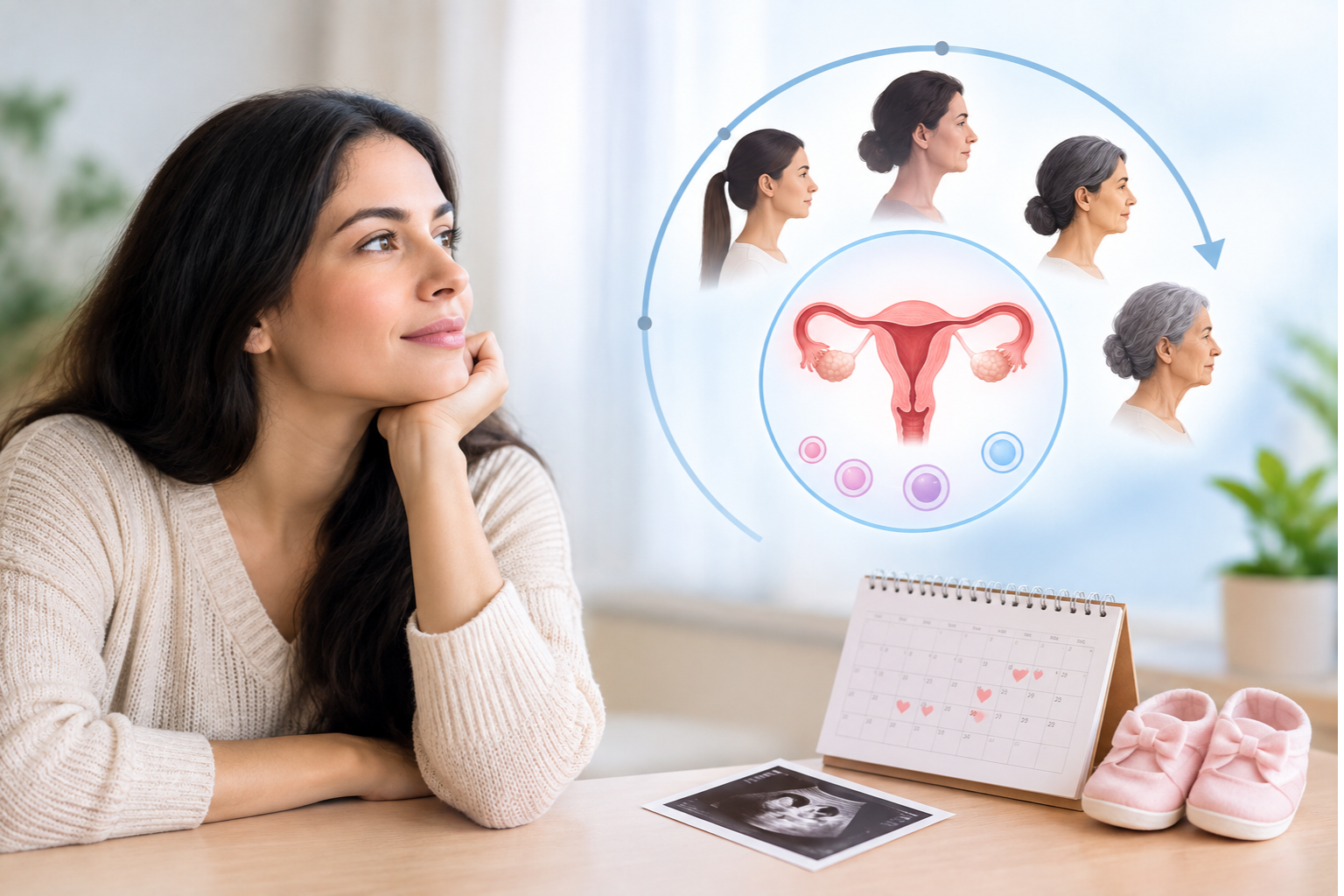
Women are born with all the eggs they'll ever have — there's no ongoing production the way there is with sperm. That finite supply declines in both quantity and quality over time, and this decline isn't linear. It's gradual through the 20s and early 30s, then accelerates, with the steepest changes typically occurring after the mid-to-late 30s.
What Changes in Your 20s
This is generally the period of highest natural fertility, with the best combination of egg quantity and quality. That said, "generally" isn't "universally" — conditions like PCOS, endometriosis, or other factors can affect fertility at any age, so being in your 20s doesn't guarantee an absence of fertility challenges. It's simply the age range where age itself is the least likely contributing factor.
What Changes Through Your Early-to-Mid 30s
Fertility begins a gradual decline during this period, more noticeable in the rate of natural conception per cycle than in an abrupt shift. Many women in this range still conceive without difficulty, though it may take somewhat longer on average compared to their 20s. Egg quality begins a more measurable decline in this window as well, which affects not just the chance of conceiving but also miscarriage rates, since chromosomal abnormalities in eggs become somewhat more common.
What Changes After 35
This is typically when the decline becomes steeper and more clinically significant. Both egg quantity (reflected in a typically lower AMH and antral follicle count compared to a decade earlier) and egg quality decline more noticeably. Miscarriage rates increase further, largely due to a higher rate of chromosomal abnormalities in eggs at this age. This is also the age range where many fertility specialists recommend not delaying evaluation if conception hasn't occurred within six months of trying, rather than the twelve-month guideline typically given to younger women.
What Changes After 40
The decline accelerates further in this decade, with natural conception rates dropping more significantly and miscarriage rates rising further still. This doesn't mean pregnancy after 40 is rare or unusual — many women do conceive naturally or with fertility treatment in their early 40s — but the odds per cycle, and per treatment attempt, are meaningfully lower than a decade earlier, which is why timelines and expectations are usually discussed more directly at this stage.
Why This Isn't the Same for Every Woman
Chronological age describes a general population trend, not an individual guarantee. Two women of the same age can have meaningfully different ovarian reserves — this is exactly why AMH testing and antral follicle counts exist, to give an individual picture rather than relying on age alone. Some women in their late 30s have a reserve more typical of someone younger; others have a reserve that's already notably reduced. Age is a strong general predictor, but it isn't a substitute for your own specific numbers.
What This Means for Planning, Practically
If you're not ready to try yet but thinking about timing, knowing your own ovarian reserve — through AMH testing and a fertility consultation — gives you real information rather than general anxiety, and can inform decisions like whether egg freezing is worth considering.
If you're actively trying to conceive, the general guideline is to seek evaluation after twelve months of trying if you're under 35, or after six months if you're 35 or older — not because trying naturally is wrong, but because earlier evaluation gives more time to address any findings while options remain broader.
If you're already past 35 or 40 and just starting to think about fertility treatment, the most useful first step isn't researching statistics further — it's an actual evaluation of your specific reserve and health, which will tell you far more about your real odds than a general age-based statistic can.
Why "Just Don't Wait" Isn't Always Realistic Advice
It's easy to say fertility declines with age and leave it there, but life circumstances — career, partnership timing, financial readiness — are real constraints that don't always align neatly with biological timelines. The more useful response to that tension isn't blanket urgency; it's getting specific information about your own situation early enough that you have real options, whether that's trying now, freezing eggs for later, or simply planning your timeline with clearer information than a general statistic provides.
Frequently Asked Questions
There isn't a single fixed cutoff, since it depends on individual ovarian reserve, but natural conception becomes progressively less likely through the 40s and is uncommon after menopause, which typically occurs around the early-to-mid 50s.
Not entirely. Treatments like IVF can help address certain fertility barriers, but they can't fully reverse age-related declines in egg quantity and quality. This is part of why age remains a relevant factor even when pursuing fertility treatment.
Male fertility also declines with age, though generally more gradually and later than female fertility. Sperm quality, including DNA integrity, can be affected by advancing age, but the decline isn't as steep or as clearly time-limited as ovarian reserve.
It's not arbitrary — it reflects a genuine, documented point where the rate of decline in egg quantity and quality tends to accelerate for most women, which is why it's used as a general guideline for adjusting evaluation timelines rather than an exact biological switch.
