
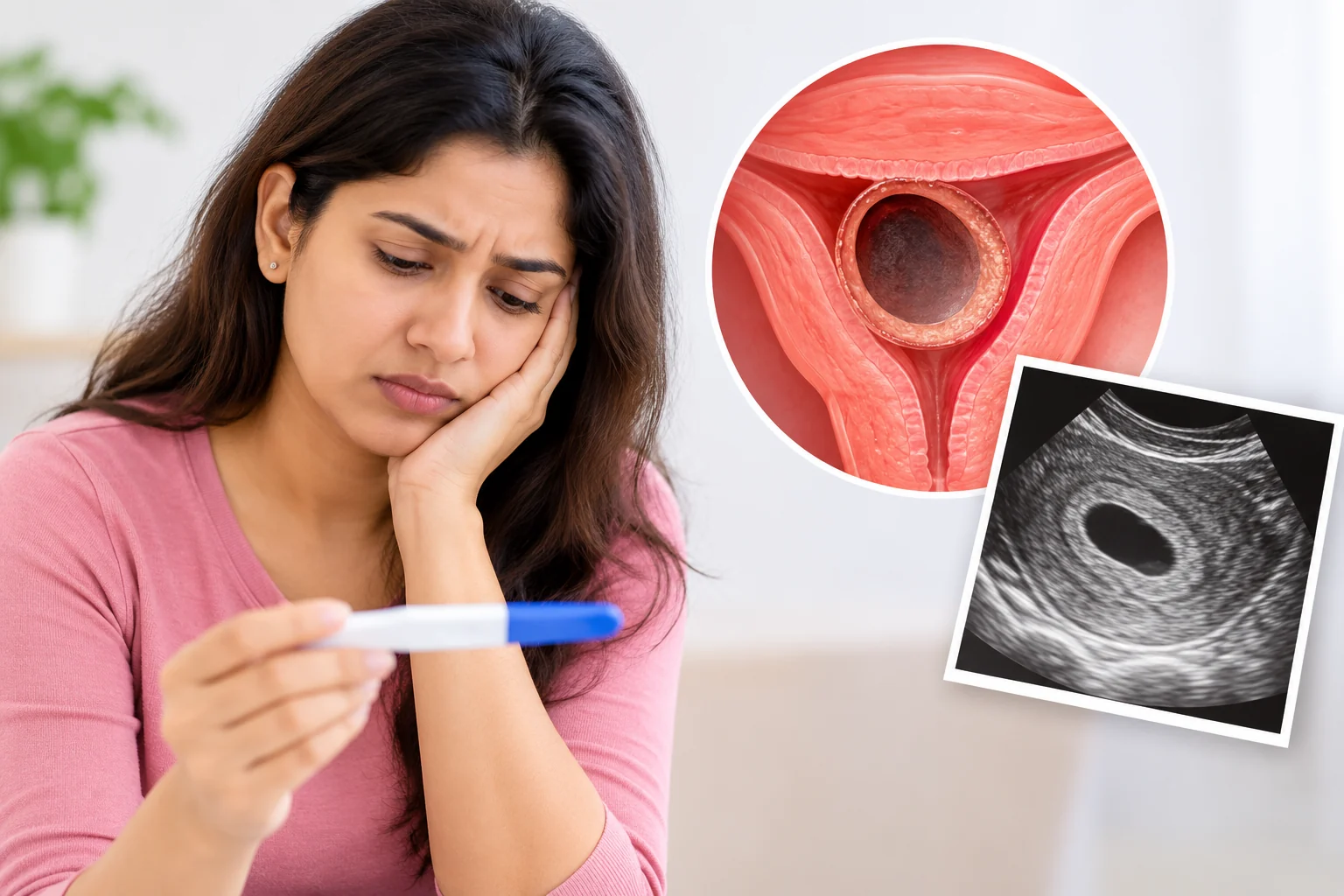
Blighted Ovum: Why It Happens and What to Do Next
QUICK ANSWER: A blighted ovum, also called an anembryonic pregnancy, is an early pregnancy where the pregnancy sac forms but an embryo does not develop inside it. It is one of the most common reasons for an early miscarriage and is usually caused by a chance chromosome error. It is confirmed by ultrasound. One blighted ovum does not usually mean you will have trouble in a future pregnancy.
Few things are as confusing as being told your pregnancy test is positive, your symptoms are real, and yet the scan shows an empty sac. If your doctor has mentioned a "blighted ovum", this guide explains what that means, how it is confirmed, what your options are, and when it makes sense to look deeper before the next pregnancy.
What does blighted ovum mean?
In a blighted ovum, the fertilised egg implants in the uterus and the tissue that would become the placenta and pregnancy sac starts to grow. But the embryo itself either never develops or stops developing so early that it can't be seen. Because the placental tissue keeps making the pregnancy hormone hCG for a while, your pregnancy test stays positive and you may still feel pregnant: tired, nauseous, with sore breasts. That is why a blighted ovum is often only found at the first scan. The medical name is anembryonic pregnancy, which simply means "a pregnancy without an embryo". Both terms describe the same thing.
How common is a blighted ovum?
Early pregnancy loss is common. ACOG reports that it happens in about 10% of clinically recognised pregnancies, and most losses happen in the first trimester (ACOG Practice Bulletin No. 200, 2018). A blighted ovum is one of the main forms of early loss. Knowing it is common does not make it hurt less. But it may help to know you are far from alone, and that this is not something you caused.
What causes a blighted ovum?
The most common cause is a problem with the chromosomes in the embryo. ACOG notes that about half of early pregnancy losses are due to chromosome abnormalities (ACOG Practice Bulletin No. 200, 2018). These usually happen by chance when the egg or sperm is formed, and they are more likely as the egg gets older.
Other factors are sometimes involved, especially when losses repeat:
- Age of the egg (chromosome errors rise with a woman's age)
- Problems in the shape of the uterus, such as a septum
- Thyroid problems or poorly controlled diabetes
- Blood clotting conditions such as antiphospholipid syndrome
- Sperm DNA damage, in some couples
What does not cause a blighted ovum: normal exercise, working, travelling, sex, stress, or eating foods like papaya or pineapple.
Signs of a blighted ovum
Many women have no warning signs. When signs do appear, they may include:
- Light spotting or brown discharge
- Cramping, like period pain
- Pregnancy symptoms that fade
- Bleeding that becomes heavier, with clots, as the pregnancy passes
None of these signs on its own proves a blighted ovum. Bleeding in early pregnancy has many causes, and some are harmless. An ultrasound is the only way to know.
How a blighted ovum is confirmed on ultrasound
Doctors are careful here, because a very early healthy pregnancy can also look "empty" if the scan is done too soon. In 2013, an expert panel published clear criteria in the New England Journal of Medicine that are still widely used (Doubilet et al., NEJM, 2013). A pregnancy is confirmed as non-viable if:
- The average diameter of the pregnancy sac is 25 mm or more with no embryo, or
- There is no embryo with a heartbeat 2 weeks or more after a scan showed a sac without a yolk sac, or
- There is no embryo with a heartbeat 11 days or more after a scan showed a sac with a yolk sac
If your scan is "suspicious but not certain", your doctor will usually ask you to come back in 7 to 14 days for a repeat scan. This is the right approach. It protects you from ending a pregnancy that might be healthy.
How long can you carry a blighted ovum?
It varies. Some pass on their own within days or weeks of the scan. Others can stay for several weeks, because the hormone levels fall slowly. Not knowing how long it will take is often the hardest part, which is why many women choose active treatment.
Treatment options for a blighted ovum
ACOG describes three safe options. The choice is yours, with your doctor's advice:
| Option | What happens | Things to know |
|---|---|---|
| Wait and watch (expectant care) | The body passes the pregnancy naturally | Can take time; bleeding can be heavy; follow-up is needed |
| Medicines | Tablets help the uterus empty | Works for many women; some still need a procedure |
| Minor procedure (suction evacuation) | The uterus is emptied under anaesthesia | Quick and predictable; allows tissue to be sent for chromosome testing |
If this is your second or third loss, ask your doctor whether the pregnancy tissue can be sent for chromosome testing. Knowing whether the embryo had a chromosome error helps explain the loss and guides what tests are needed next.
Pregnancy after a blighted ovum
After a single blighted ovum, most women go on to have a healthy pregnancy. Because the usual cause is a one-off chromosome error, it does not usually repeat for the same reason.
Your periods usually return within 4 to 6 weeks. You can try again once you feel ready and your doctor confirms the uterus is clear.
When a blighted ovum needs further tests
ESHRE defines recurrent pregnancy loss as two or more pregnancy losses, which includes blighted ovum and very early losses (ESHRE Guideline: Recurrent Pregnancy Loss, update 2022). If that applies to you, a focused evaluation is reasonable before the next pregnancy. Depending on your history, this may include:
- Chromosome results from the pregnancy tissue, if available
- Antiphospholipid antibody testing
- Thyroid tests
- Imaging of the uterus, such as a 3D scan or hysteroscopy
- Chromosome tests (karyotype) for both partners in selected couples
- A sperm DNA fragmentation test in some couples
If you are older or have had several losses linked to chromosome errors, your fertility specialist may discuss IVF with embryo genetic testing (PGT-A). It is not right for everyone and is not a guarantee, but for some couples it is worth discussing.
Taking care of yourself
A blighted ovum is a real loss. Some women feel strangely numb because "there was no baby to see". Others feel heartbroken. Both are normal. Give yourself time, lean on people you trust, and ask for counselling support if the sadness feels heavy or lasts. If you'd like to understand your results or plan the next step, you can contact Dr. Durga Vytla's clinic at Continental Fertility Center, Financial District, Hyderabad.
Written and medically reviewed by Dr. Durga Vytla, MBBS, DGO (PG Diploma in Obstetrics & Gynaecology), Fellowship in Reproductive Medicine (Institute of Human Reproduction, Guwahati), advanced training in reproductive medicine at UKSH, Germany. Fertility Specialist, Obstetrician & Gynaecologist (IVF/ICSI), Continental Fertility Center, Continental Hospitals, Financial District, Hyderabad. Member, ISAR and FOGSI.
Registration: Telangana State Medical Council / SMR No. 77030
Last medically reviewed: [25-11-2026] · This article is for general information and isn't a substitute for a personal medical consultation.
Frequently Asked Questions
It is an early pregnancy where the pregnancy sac grows but no embryo develops. The medical term is anembryonic pregnancy.
Once it has been confirmed using the standard ultrasound criteria, no. If the scan is uncertain, your doctor will repeat it before deciding, so a healthy early pregnancy is not mistaken for a blighted ovum.
The placental tissue keeps making hCG for a while, so pregnancy symptoms and a positive test can continue even without an embryo.
No. It is usually caused by a chance chromosome error in the embryo. Daily activities, work, stress and food do not cause it.
After one blighted ovum, most women have a healthy next pregnancy. After two or more losses, an evaluation is recommended.
No. In a chemical pregnancy, the loss happens before a sac can be seen. In a blighted ovum, a sac is seen on the scan but has no embryo.
