
Follicular Study Explained: Why It’s Done and What the Results Mean
If you've been told you need a "follicular study" and you're picturing something complicated or invasive, the reality is much simpler than the name suggests — and much more useful than most patients realize going in. It's one of the most common tests in fertility evaluation, and understanding what it's actually tracking makes the whole process feel far less like a mystery.
What a Follicular Study Actually Is
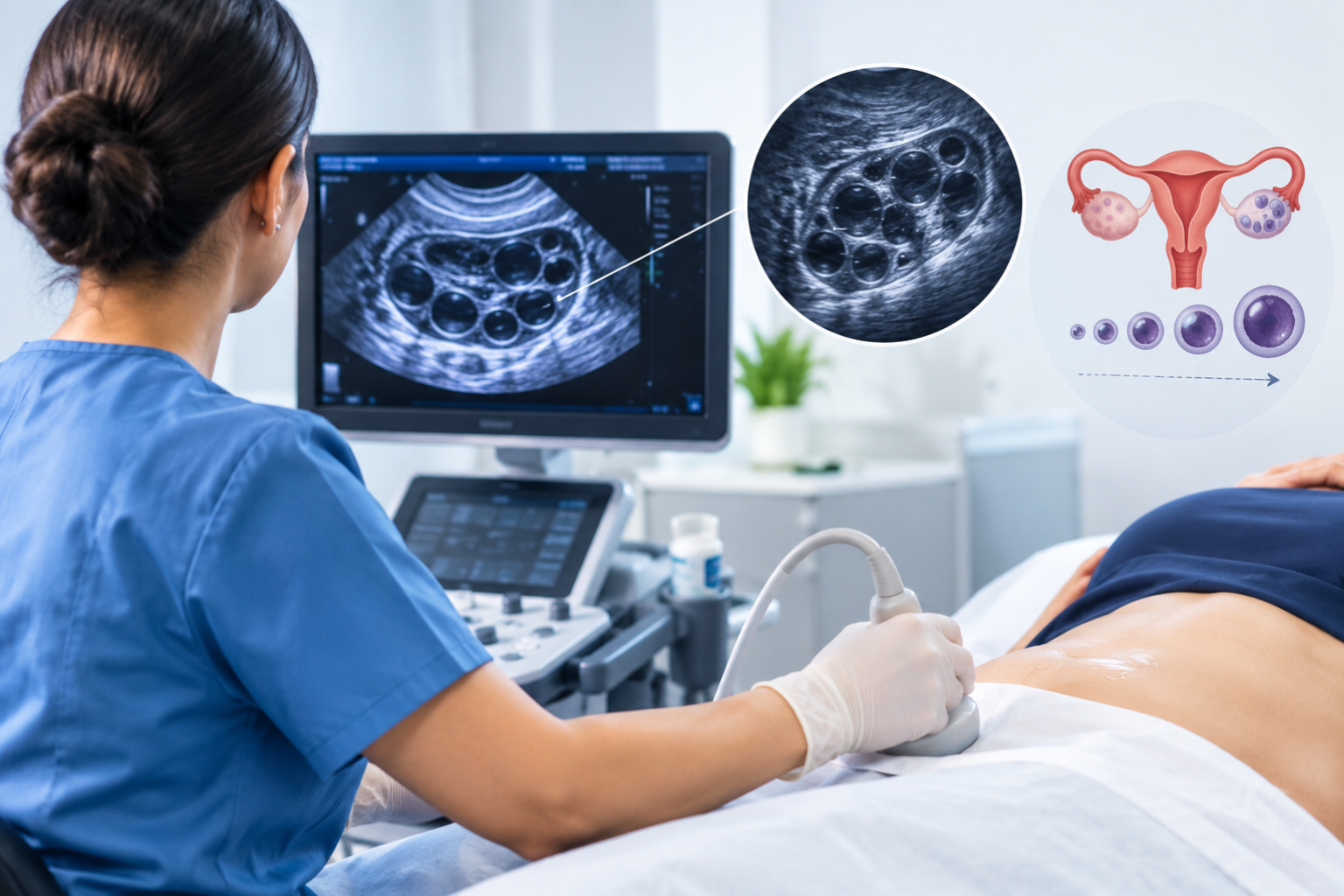
A follicular study is a series of transvaginal ultrasound scans done over several days during your menstrual cycle, tracking the growth of the follicles in your ovaries — the small fluid-filled sacs that each contain a developing egg. Rather than a single snapshot, it's a short story told over a handful of visits, watching how a follicle grows day by day until it either releases an egg (ovulation) or doesn't.
Why It's Done Over Multiple Visits, Not Just Once
A single ultrasound can tell you how things look at that moment, but ovulation is a process, not an event you can catch on a random day. A typical follicular study involves scans starting a few days before the expected ovulation window, repeated every one to three days, tracking:
- How many follicles are developing
- How quickly the leading follicle is growing (a normal rate is roughly 1–2mm per day as it approaches maturity)
- The thickness and pattern of the uterine lining, which needs to reach a suitable thickness to support implantation
- Confirmation of whether and when ovulation actually occurred
Who Typically Needs One
A follicular study is commonly recommended for women with irregular cycles where the ovulation window isn't predictable from cycle timing alone, for confirming whether ovulation is happening at all, for timing IUI precisely around ovulation, and for monitoring the ovarian response during a stimulated cycle (whether with oral medication, injectables, or as part of IVF).
What the Results Actually Tell You
A follicle that grows steadily and reaches a mature size (typically around 18–24mm) before disappearing on a later scan generally indicates ovulation has occurred — the follicle released its egg.
A follicle that grows but doesn't disappear, instead persisting or turning into a cyst-like structure, may indicate the egg wasn't released despite the follicle developing — a pattern sometimes called a "trapped" or unruptured follicle, and it's exactly the kind of thing that would go unnoticed without this kind of tracking.
Multiple follicles developing simultaneously is expected and often desirable during a stimulated cycle for IUI or IVF, since it means more chances at retrieving a viable egg, but is monitored carefully to avoid overstimulation.
A thin or poorly developing uterine lining alongside good follicle growth flags a separate issue worth addressing — a mature egg with nowhere receptive to implant doesn't lead to pregnancy, which is why the lining is tracked just as closely as the follicle itself.
What Happens With the Findings
The findings from a follicular study directly shape what happens next. For a natural cycle being monitored for timing, ovulation confirmation tells you and your doctor the best window for intercourse or IUI. For a stimulated cycle, the growth pattern determines exactly when a trigger injection is given to finalize egg maturation before IUI or egg retrieval — timing that, done even a day off, can meaningfully affect the outcome. For someone whose scans repeatedly show follicles that don't release eggs, this becomes useful diagnostic information pointing toward ovulation dysfunction that needs its own treatment approach.
What to Expect During the Visits Themselves
Each visit is a routine transvaginal ultrasound, generally quick and not particularly uncomfortable, though scheduling can feel demanding since visits are often needed every one to two days during a specific window — which is worth planning around rather than being caught off guard by. Most clinics try to time the visits as precisely as possible to minimize the total number needed while still capturing the growth pattern accurately.
Why This Test Matters More Than Its Simplicity Suggests
It's easy to underestimate a test that's "just an ultrasound," but a follicular study answers questions that no single blood test or one-time scan can: not just whether ovulation happens, but when, how reliably, and what the uterine environment looks like at the same time. For couples trying to conceive naturally, undergoing IUI, or going through IVF, this timing information is often the difference between a well-timed attempt and a mistimed one.
Frequently Asked Questions
This varies by cycle and by patient, but a typical follicular study involves three to five scans spaced a few days apart, starting before the expected ovulation window and continuing until ovulation is confirmed or the window closes.
A transvaginal ultrasound involves mild pressure but is not typically painful. Most patients tolerate the repeated scans without significant discomfort.
Not on its own — it specifically evaluates ovulation and follicle development. A complete fertility evaluation usually combines it with hormone testing, a semen analysis for the partner, and other assessments depending on the full clinical picture.
A single cycle with confirmed ovulation not resulting in pregnancy is common and doesn't necessarily indicate a problem — natural conception rates per cycle are well below 100% even in couples with no fertility issues. It becomes more relevant to investigate further after several cycles without success.
