
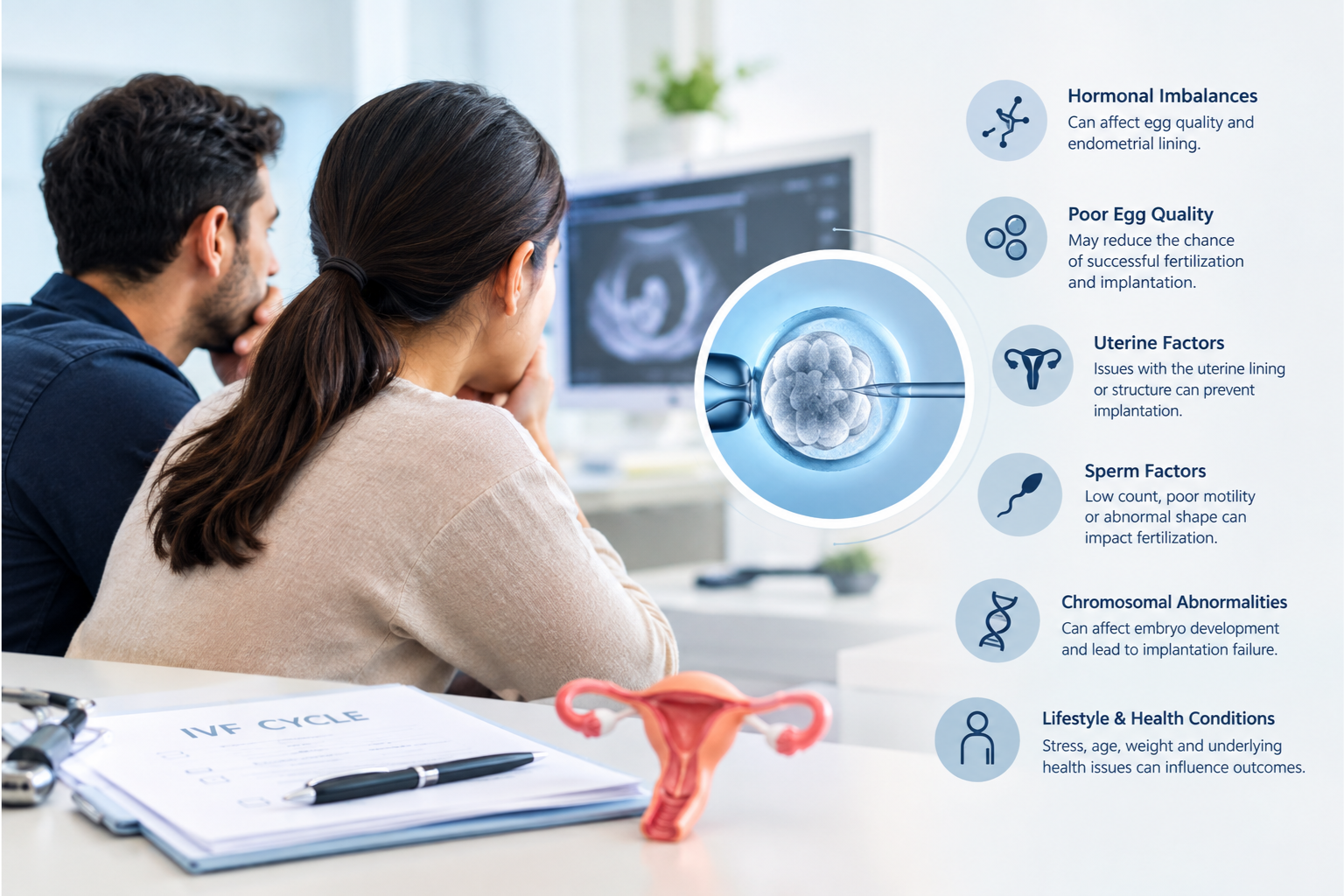
Why IVF Cycles Fail: Real Reasons Beyond “Bad Luck”
"It just didn't work this time" is one of the least satisfying sentences in medicine, and it's the one a lot of patients hear after a failed IVF cycle. It's not wrong, exactly — IVF genuinely isn't guaranteed, even under ideal conditions — but it's incomplete. Most failed cycles have identifiable contributing factors, and understanding them is the difference between trying again with the same plan and trying again with a better one.
Embryo-Related Reasons
Chromosomal abnormalities. This is the single largest contributor to IVF failure, particularly as age increases. An embryo can look perfectly graded under the microscope and still carry a chromosomal abnormality incompatible with a successful pregnancy — something visual grading alone can't detect. This is exactly why PGT (preimplantation genetic testing) has become a meaningful tool for certain patients, particularly after a previous failed cycle or at older maternal age.
Poor embryo development. Not every fertilized egg develops into a transferable embryo. Development can stall at various stages for reasons related to egg quality, sperm quality, or lab culture conditions — and reviewing exactly where development stalled in a previous cycle can point toward which factor needs the most attention next time.
Implantation-Related Reasons
Uterine factors. Polyps, fibroids, scar tissue, or a thin endometrial lining can all interfere with an otherwise good embryo implanting successfully. Many of these are identifiable on ultrasound or hysteroscopy and are treatable before the next attempt — which is why a uterine cavity assessment is a standard part of reviewing a failed cycle.
Endometrial receptivity timing. Occasionally, the issue isn't the embryo or the uterus individually, but the timing between them — the embryo transferred outside the specific window when the uterine lining is genuinely receptive. This is a more specialized area of investigation, relevant particularly after repeated unexplained failures with good-quality embryos.
Immunological and clotting factors. In select cases, particularly after multiple unexplained failures, underlying immune or clotting factors are investigated, since they can occasionally interfere with implantation. This isn't a first-line explanation for every failed cycle, but it's part of a thorough workup after repeated failures with no other clear cause.
Factors Related to the Stimulation Cycle Itself
Ovarian response. Whether the ovaries respond as expected to stimulation medication affects both the number and quality of eggs retrieved. A poor response — fewer eggs than anticipated — sometimes calls for a different protocol next time rather than simply repeating the same approach.
Protocol mismatch. Not every stimulation protocol suits every patient, and part of reviewing a failed cycle is asking honestly whether the specific medications and doses used were well-matched to that patient's ovarian reserve and prior response, or whether a different approach is worth trying.
Lifestyle and Health Factors
Underlying undiagnosed conditions. Thyroid dysfunction, elevated prolactin, undiagnosed endometriosis, or untreated infections can all affect IVF outcomes and sometimes go unaddressed if a full workup wasn't done before the first cycle.
Sperm quality on the day. Sperm parameters can vary between samples, and a suboptimal sample on the day of egg collection — even in a partner with generally normal fertility — can affect fertilization rates in ways that a single semen analysis months earlier wouldn't have predicted.
What a Proper Review After a Failed Cycle Actually Involves
A thorough post-failure review isn't a single conversation that ends in "let's just try again." It typically includes:
- A detailed look at exactly how the previous cycle progressed — egg numbers, fertilization rates, embryo development, and grading at each stage
- A uterine cavity assessment if one wasn't recently done
- A review of whether the stimulation protocol matched the patient's ovarian reserve and response
- Consideration of additional testing — genetic, immunological, or receptivity-related — when repeated failures have occurred without a clear explanation
- An honest conversation about whether the next attempt should look different, and specifically how
Why "Just Try Again" Is Sometimes the Right Answer, and Sometimes Isn't
To be clear, not every failed cycle points to a fixable problem — sometimes a good-quality embryo simply doesn't implant, and a repeat attempt with the same approach is entirely reasonable. The goal of a proper review isn't to find a problem where none exists; it's to make sure that if something identifiable did contribute to the failure, it gets addressed rather than repeated silently.
Moving Forward After a Failed Cycle
A failed IVF cycle is disorienting, and it's fair to want more than "let's try again" as an answer. A specialist reviewing your specific cycle — the numbers, the timing, the findings — can usually tell you whether there's something concrete to adjust, or whether the plan genuinely was sound and deserves another attempt. Either answer is more useful than no answer at all.
Frequently Asked Questions
There's no fixed universal number, but many specialists recommend a more detailed workup after two to three unsuccessful cycles with good-quality embryos, sooner if something specific in the first cycle raises a concern worth investigating immediately.
Not necessarily. IVF success rates are never 100% even in ideal circumstances, and a single failed cycle with a good-quality embryo can simply reflect the statistical nature of implantation rather than an underlying problem.
PGT reduces the chance of transferring a chromosomally abnormal embryo, which is a major cause of failure, but it doesn't address uterine, immunological, or other implantation-related factors — it's one tool among several, not a guarantee on its own.
This depends entirely on how the first cycle went. If the response and embryo development were good, the same protocol may be reasonable. If the response was poor or unexpected, adjusting the protocol for the next attempt is often recommended.
