
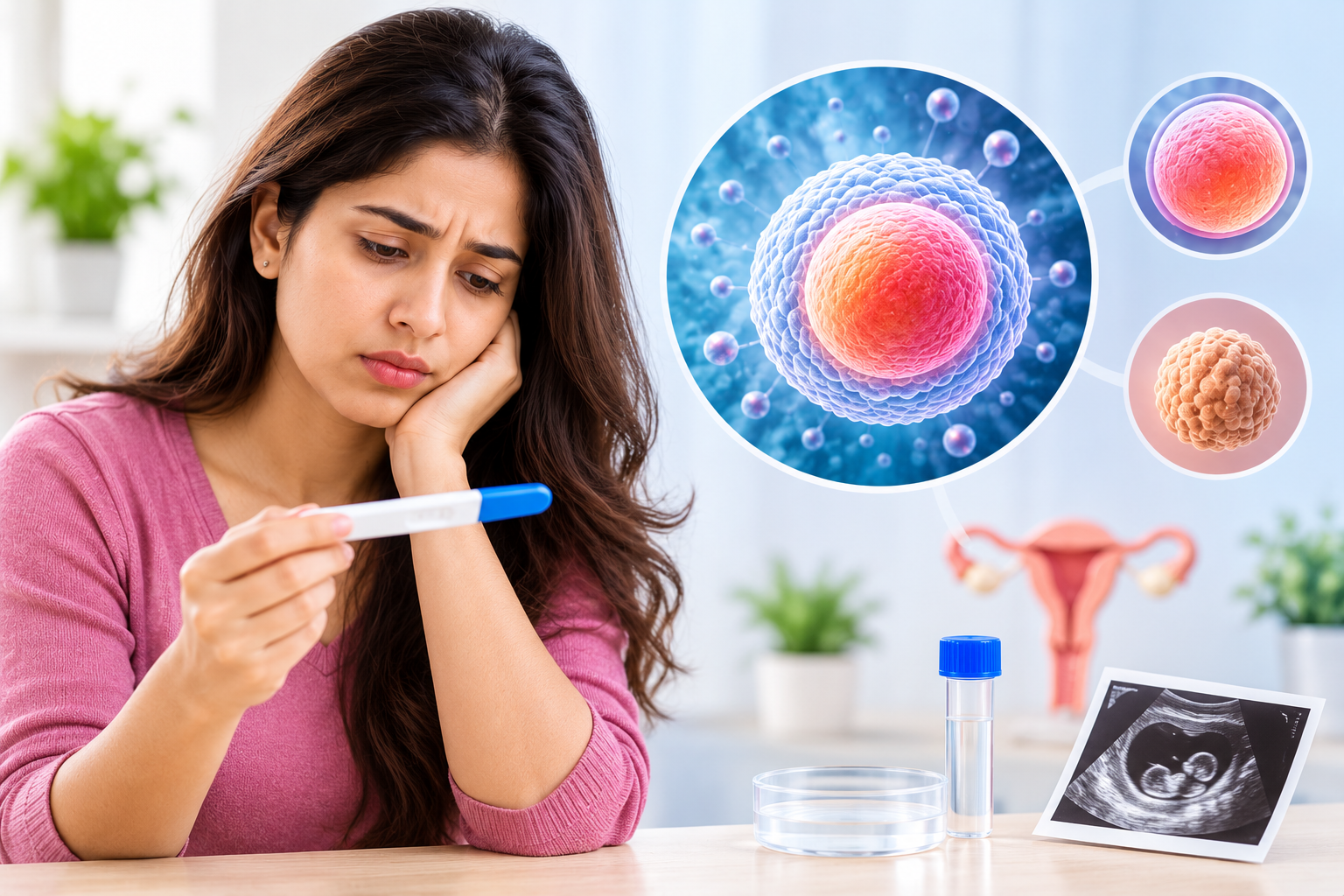
Poor Egg Quality: The Signs, the Tests, and What Can Actually Help
QUICK ANSWER : Egg quality means how likely an egg is to be chromosomally normal and able to grow into a healthy embryo. It is mostly shaped by a woman's age. There is no blood test that measures it directly: AMH and antral follicle counts measure egg numbers, not quality. Doctors judge quality from how eggs and embryos behave in IVF. Healthy habits help, but no food or supplement has been proven to reverse poor egg quality.
"Your egg quality is poor." It's one of the hardest things to hear, especially after an IVF cycle that didn't work. And when you search online, you find hundreds of diets, powders and "30-day plans" promising to fix it. This guide is here to give you the honest picture: what egg quality really means, how it is assessed, what the signs are, and which advice is backed by evidence and which isn't.
Egg quality vs egg quantity: not the same thing
These two get mixed up all the time.
- Egg quantity (ovarian reserve) is how many eggs you have left. It is estimated with an AMH blood test and an antral follicle count on ultrasound.
- Egg quality is whether an individual egg has the right number of chromosomes and the energy to be fertilised and grow into a healthy embryo.
You can have a low AMH with good-quality eggs, or a normal AMH with eggs that struggle. If your concern is low AMH, our guide on what low AMH means for your treatment options covers that in detail. This article is about quality.
Why egg quality changes
Every woman is born with all the eggs she will ever have. Those eggs age with her. As they get older, the machinery that divides chromosomes evenly works less reliably, and more eggs end up with too many or too few chromosomes. This is called aneuploidy. A large study of more than 15,000 embryo biopsies found that chromosome errors in embryos rise predictably after the age of about 26 (Franasiak et al., Fertility and Sterility, 2014). This is the single biggest reason fertility changes with age. It is biology, not something a woman did wrong. Other factors that can affect egg quality include:
- Smoking, which the American Society for Reproductive Medicine links to faster loss of eggs and earlier menopause (ASRM Practice Committee, Smoking and infertility, 2018)
- Endometriosis, especially with ovarian cysts
- Past ovarian surgery, chemotherapy or radiation
- Some genetic conditions
Signs of poor egg quality
This is the part most websites get wrong. Poor egg quality has no symptoms you can feel. Your periods can be perfectly regular. You won't notice anything in your body. The "signs" doctors actually rely on usually come from tests and from fertility treatment:
- Repeated miscarriages, especially when the pregnancy tissue shows chromosome errors
- In IVF: a lower proportion of mature eggs at retrieval, poor fertilisation, or embryos that stop growing before day 5
- Embryos that are repeatedly chromosomally abnormal on genetic testing (PGT-A)
- Failed IVF cycles despite a good number of eggs
Even these are clues, not proof. Fertilisation and embryo growth also depend on sperm quality and on lab conditions. That's why a good evaluation looks at both partners.
How to check egg quality
There is no single egg quality test. Here is what each test can and can't tell you:
| Test | What it measures | Does it tell you egg quality? |
|---|---|---|
| AMH blood test | Approximate number of eggs left | No. It measures quantity |
| Antral follicle count (ultrasound) | Number of small follicles this cycle | No. It measures quantity |
| Day 2–3 FSH | How hard the brain is working to stimulate the ovaries | Not directly; a very high FSH may point to reduced reserve |
| Egg maturity at IVF retrieval | How many eggs were mature | A partial clue |
| Embryo development in the lab | Fertilisation and growth to blastocyst | A useful clue, alongside sperm factors |
| PGT-A on embryos | Chromosome number of each embryo | The closest thing to a direct measure, but only available during IVF |
Be cautious of any "egg quality test" offered as a simple blood test. Your age remains the most reliable predictor.
How to improve egg quality: what the evidence says
Let's be honest about what can and can't be changed. You can't reverse the age of your eggs. But you can protect the eggs you have and give each cycle its best chance.
What is worth doing
- Stop smoking, including second-hand smoke at home.
- Cut down alcohol while trying to conceive.
- Aim for a healthy weight. Both being very underweight and being overweight can affect ovulation and treatment.
- Treat what can be treated: thyroid problems, diabetes, and endometriosis where it is affecting the ovaries.
- Take folic acid every day. It doesn't change egg quality, but it protects your future baby.
- Get your partner tested. Sperm quality affects fertilisation and embryo growth, and is often easier to improve.
Food to improve egg quality
Many of the most-searched lists ("top 10 foods to improve female egg quality") present single foods as if they were medicine. No single food has been shown to improve egg quality. What is reasonable is a balanced, mostly home-cooked diet: vegetables, fruit, whole grains, dal and pulses, nuts, fish or eggs if you eat them, and fewer sugary drinks and ultra-processed snacks. This pattern supports general and pregnancy health. It is good for you, but it is not a cure.
Supplements for egg quality
Antioxidant supplements are popular, and coenzyme Q10 is the one most often asked about. The most thorough review so far, by Cochrane, looked at 63 trials with 7,760 women and concluded that we are uncertain whether antioxidants increase live births, because the evidence is of very low quality (Showell et al., Cochrane Database of Systematic Reviews, 2020). That doesn't mean every supplement is useless. It means the claims are bigger than the proof. Please don't start supplements on your own during treatment. Discuss them with your doctor, who will consider your history and anything else you are taking.
"Improve egg quality in 30 days"
Eggs mature over several months before they are released, and the age of the egg can't be changed. A month of healthier habits is a good start, but no plan can promise to transform egg quality in 30 days.
What can help if poor egg quality is suspected
If tests or past cycles suggest egg quality is the main barrier, a fertility specialist may talk to you about:
- A tailored stimulation plan that suits your ovarian response
- Growing embryos to day 5 (blastocyst culture), which helps show which embryos are developing well
- PGT-A, for selected women, to avoid transferring embryos with chromosome errors. It doesn't improve egg quality; it helps with selection.
- Collecting and freezing embryos over more than one cycle in some cases
- Donor eggs, when your own eggs are very unlikely to work. This is a personal choice, discussed openly and never pushed.
You'll also hear about newer "add-on" treatments. ESHRE reviewed 42 recommendations on IVF add-ons in 2023 and found that none could be based on high-quality evidence (ESHRE Good Practice Recommendations on Add-ons, Human Reproduction, 2023). If you are offered an add-on, ask what the evidence shows, what it costs, and whether you would be better off without it.
When to see a fertility specialist
Consider a consultation if:
- You are 35 or older and have been trying for six months or more
- You have had a failed IVF cycle and were told your eggs or embryos were the problem
- You have had two or more pregnancy losses
- You have endometriosis or have had ovarian surgery
If you'd like your past cycle reports reviewed, you can contact Dr. Durga Vytla's clinic at Continental Fertility Center, Financial District, Hyderabad.
Written and medically reviewed by Dr. Durga Vytla, MBBS, DGO (PG Diploma in Obstetrics & Gynaecology), Fellowship in Reproductive Medicine (Institute of Human Reproduction, Guwahati), advanced training in reproductive medicine at UKSH, Germany. Fertility Specialist, Obstetrician & Gynaecologist (IVF/ICSI), Continental Fertility Center, Continental Hospitals, Financial District, Hyderabad. Member, ISAR and FOGSI.
Registration: Telangana State Medical Council / SMR No. 77030
Last medically reviewed: [27-11-2026] · This article is for general information and isn't a substitute for a personal medical consultation.
Frequently Asked Questions
There are no physical symptoms. Clues come from tests and treatment: repeated miscarriages, poor fertilisation or embryo growth in IVF, and chromosomally abnormal embryos on PGT-A.
No. AMH estimates how many eggs you have left, not how healthy each egg is.
The age of an egg can't be changed. Stopping smoking, a healthy weight, treating medical conditions and a balanced diet help protect the eggs you have.
Cochrane's 2020 review found the evidence for antioxidants is very low quality, so it is uncertain whether they improve live births. Ask your doctor before starting any supplement.
Many women can, but it may take longer or need treatment. Your doctor can explain your options based on your age and test results.
No. Low reserve means fewer eggs. Poor quality means a higher share of eggs with chromosome problems. They can occur together or separately.
